
Scaffolding is a Trap
A new study questions everything you know, and an old study by Rosenshine will surprise you too.

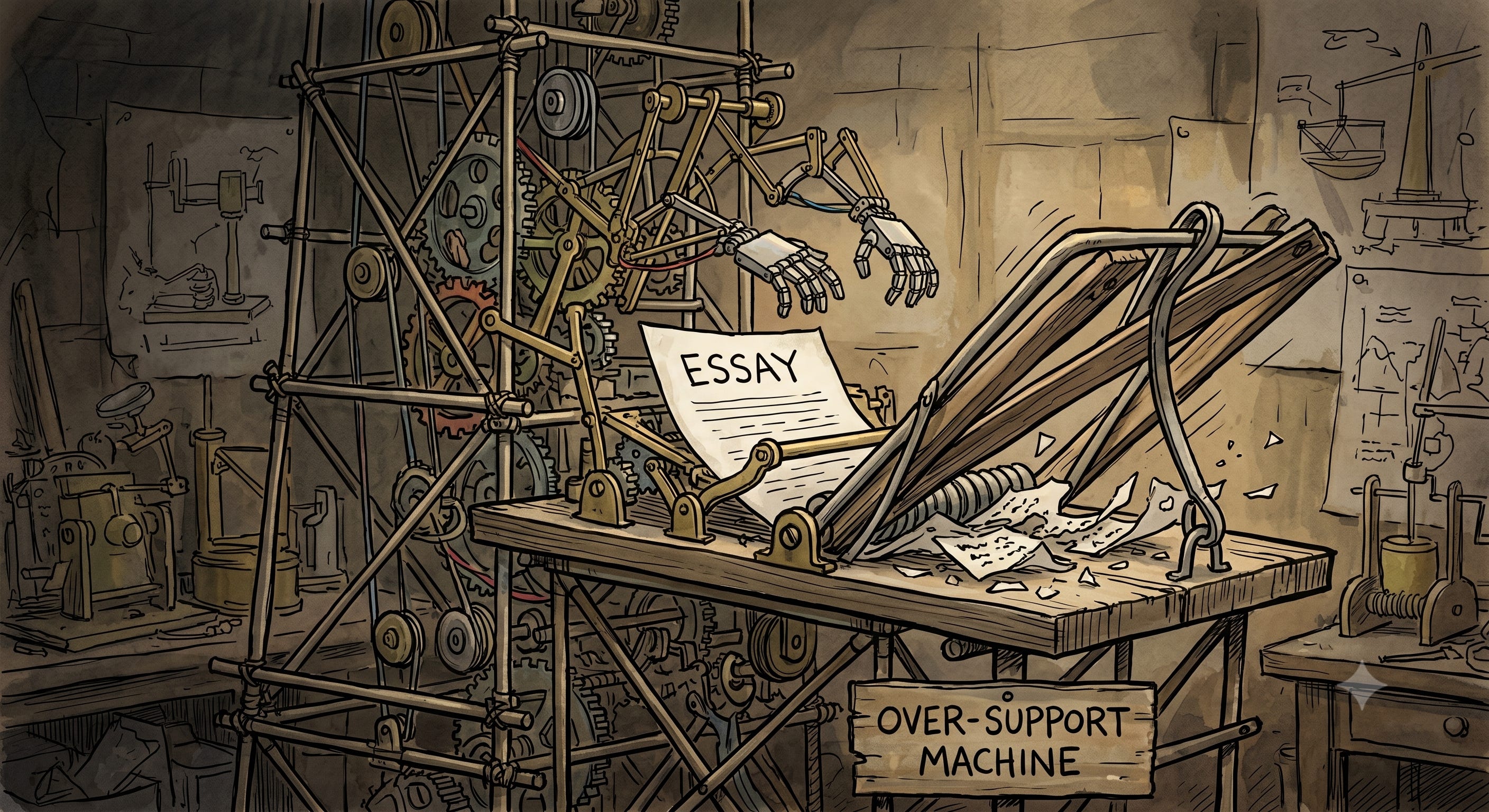
I’ve always known scaffolding is a trap. It slows everything down, so it feels like forever.
It makes you feel great as a teacher, because your students are always improving. But are you just filling a bucket, one cupfull at a time?
Turn on the tap.
I’ve been teaching for 34 years, but I’m pretty sure I knew this from day one, and the experience of accelerating student progress has simply proved it to me again, and again, again.
Tasks need to be simple. But thinking needs to be hard. Thinking needs to be complex. Scaffolding is the enemy of complex thinking.
How Much Scaffolding is the Minimum?
When your instructor taught you to drive, you were out on the road after the first 30 minutes. Really complex. Working memory very much overloaded. Yes, scaffolding was there, but was very quick, just in the initial teaching: 30 minutes in the car park, then on the road risking the lives of thousands. In 30 hours of driving lessons, only those first 30 minutes were scaffolded.
Your driving instructor didn’t believe in scaffolding, working memory and cognitive load.
When you learned to swim, the teacher gave you arm bands, but did not fart about with scaffolded activities. They demanded that you swim across the pool, pause, come back again. Then they gave you a small technique to practise, but immediately made you swim two widths, including that technique with whatever else your hands, arms, feet and legs and head were doing. Oh, and don’t forget to breathe.
Minimal scaffolding, a lot of cognitive overload. It didn’t take long for the arm bands to come off. And then it was this whole stroke, and that whole stroke, and more, more, more. Then treading water, diving for bricks. Cognitive overload.
It has been the same in my classroom. Always the shortest path:
Here’s the whole thing I want you to master first.
Ok, let’s play around with a part of it - a small scaffold.
Right, now let’s try a big chunk of the whole thing again, where you will have to connect loads of stuff in addition to the small part I just scaffolded for you.
More, more, more. The whole first, little parts next, back to the whole. Overload.
And this feels wrong when I write it down. Every blogger says it’s wrong. So, I’m probably wrong, right?
Also, I’m deeply suspicious of my certainties. I’m always on the lookout for ideas which prove me wrong. So, why haven’t I come to see that I’m just wrong, wrong, wrong?
Well, pupil progress for one. But what if that is in spite of my lack of scaffolding, rather than because? As always, I turn to the research.
So what does the research actually say?
The most obvious one is Ronsenshine, Principle 7, the 80% success rate. When you need an 80% success rate, I must be wrong.
Rosenshine says I’m wrong. Think again, Dominic.
Not so fast my friends. Rosenshine has more to say.
7. Obtain a high success rate:
It is important for students to achieve a high success rate during classroom instruction.
In two of the major studies on the impact of teachers, the investigators found that students in classrooms with more effective teachers had a higher success rate, as judged by the quality of their oral responses during guided practice and their individual work.
In a study of fourth-grade mathematics, it was found that 82 percent of students’ answers were correct in the classrooms of the most successful teachers, but the least successful teachers had a success rate of only 73 percent.
A high success rate during guided practice also leads to a higher success rate when students are working on problems on their own. The research also suggests that the optimal success rate for fostering student achievement appears to be about 80 percent. A success rate of 80 percent shows that students are learning the material, and it also shows that the students are challenged.
The most effective teachers obtained this success level by teaching in small steps (i.e., by combining short presentations with supervised student practice), and by giving sufficient practice on each part before proceeding to the next step.
These teachers frequently checked for understanding and required responses from all students.
It is important that students achieve a high success rate during instruction and on their practice activities. Practice, we are told, makes perfect, but practice can be a disaster if students are practicing errors! If the practice does not have a high success level, there is a chance that students are practicing and learning errors. Once errors have been learned, they are very difficult to overcome.
Providing guided practice after teaching small amounts of new material, and checking for student understanding, can help limit the development of misconceptions.
What Rosenshine Seems to Say
So, if we go back to Rosenshine, perhaps we have misinterpreted scaffolding. These students were practising real problems, whole questions, not just parts of questions.
The key thing is that teachers checked each student reached 80% success before they moved on.
Imagine the classroom. This does not mean 80% of the questions they have answered. It means: I’ve been teaching you this quadratic and I’ve taken you through a series of practices. Now, here are 5 questions to see how much you’ve understood. It is these final 5 which will give us our 80% figure - everyone in the class needs at least 4 out of 5 correct. Only then can I (you) move on.
That does not mean I needed my students to achieve 80% success in the preceeding questions. If I pitched 10 of them wrongly, and students scored only 50%, that wouldn’t matter. What would matter is that I checked for understanding, kept altering my pitch of difficulty, and then, for my final 5 questions, pitched those at the right level for 80% success rate for each student.
The point of this is that I don’t need to make my lesson so easy that students succeed all the time on the way to mastering whatever I am delivering. They just need that 80% success rate at the end.
Am I Having My Cake and Eating It?
No. It turns out I am not some crazy old timer, still prospecting for gold in a worn out seam. Here’s a new study on desirable difficulties, interleaving and cognitive overload.
This research study explores the most effective ways to study and learn new information, challenging the common advice that you should always start with easy tasks and slowly work your way up to harder ones.
The study challenges the common advice that you should always start with easy tasks and slowly work your way up to harder ones.
To understand the findings, it helps to first understand a few technical terms the researchers use about how the brain works:
Working Memory: This is your brain’s short-term workspace where you process new information, but it has very limited capacity and can easily be overwhelmed.
Long-Term Memory: This is your brain’s permanent storage. The goal of studying is to move information from your working memory into this long-term storage so you can easily access it later.
Cognitive Load: This simply refers to the amount of mental effort or “brainpower” a task requires. The researchers break this down into three types:
Intrinsic Cognitive Load: The natural difficulty of the subject you are learning.
Extraneous Cognitive Load: Unnecessary mental effort caused by bad teaching, confusing instructions, or distractions.
Germane Processes: The “good” mental effort your brain uses to actually connect ideas together and build permanent memories.
Desirable Difficulties: These are study techniques that deliberately make learning feel harder and slower in the moment, but actually force your brain to remember the information much better in the long run.
Interleaved vs. Blocked Practice: Blocked practice is studying the exact same type of problem over and over before moving to the next (e.g., AAA, BBB, CCC), while interleaved practice is a “desirable difficulty” where you mix different types of problems together (e.g., ABC, BCA, CAB). Interleaving forces your brain to constantly “reload” information, which makes the memory stronger.
The Experiment
To test the best way to learn, the researchers had 132 participants learn how to conjugate Italian verbs. They split them into different groups to test two main things:
Did they mix up the verb types (interleaved) or practise one at a time (blocked)?
Did they start with really hard tasks that required them to use all the verb endings right away (constantly high complexity), or did they start with easy tasks that slowly added more verb endings (gradually increasing complexity)?
The Results
Two days later, the participants took a test to see what they remembered. The results showed that the traditional way of studying is actually the least effective:
Diving into the deep end works best: The students who performed the best on the final test - completing it faster and with fewer mistakes - were the ones who mixed up their practice (interleaved) and faced constantly high complexity from the very first minute. The students who started easy and did blocked practice performed the worst.
Your brain needs a challenge to care: Surprisingly, the students who started with the hardest tasks actually reported feeling less mentally overwhelmed than the students who started with the easy tasks. The researchers concluded that when a task is highly complex right away, it forces your brain to activate those “germane processes” to figure it out and build deep understanding. If a task is too easy to solve, your brain basically gets lazy, doesn’t invest the effort to deeply process the information, and you don’t build strong memories.
Hard tasks don’t crush your motivation: You might guess that giving students a super hard, mixed-up task on day one would make them feel frustrated or want to quit. However, the study found that facing these complex, desirable difficulties did not lower the students’ interest in the task or their confidence in their ability to succeed.
It is worth looking at the EEF 5 a Day
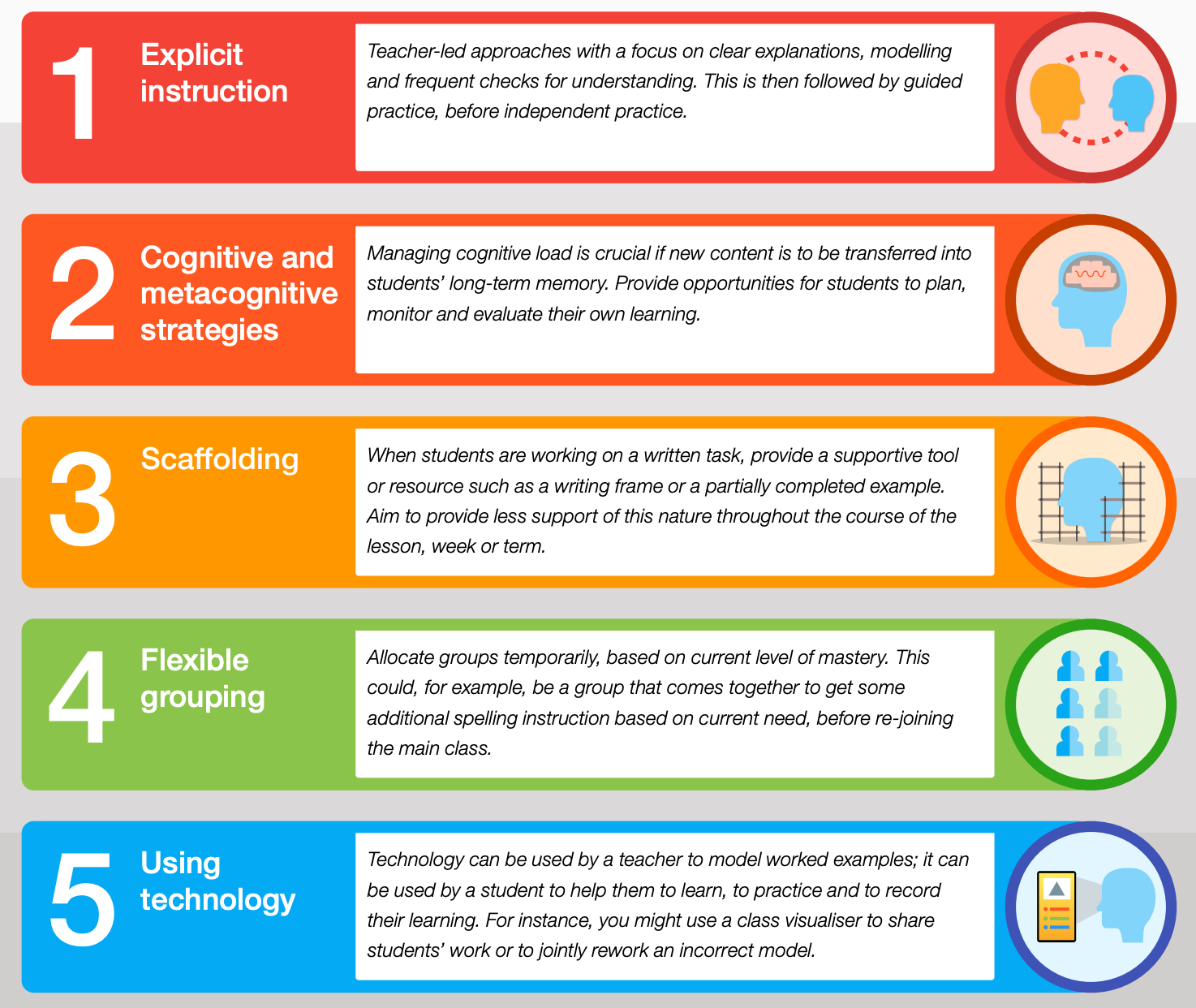
Look at what is implied. A writing task is something significant, beyond sentence and even paragraph level.
Even then, you are expected to remove it as soon as possible, beginning with the lesson.
Above all, you need to plan a sequence for how you are going to remove the scaffolding. If there is no plan, it is not scaffolding. It is simply the enemy of thought and learning.
Let’s explore what this means for your teaching, using Macbeth as an example.
Read the play quickly. Understand plot and character. That’s it. In fact you could do that without watching the play, you could just use a video. (I want you to read the play for other reasons - but it is not necessary if you are happy not to scaffold).
Read some essays. Grade 5, 7 and 9. Different themes and characters. Competing views. You’ll do some of these tasks after reading one essay, and some after you have read all of them.
You can, if you are scared of giving students the answers from the start (some teachers think this is cheating), do all these exercises without reading any essays first.
Not the shortest path, but still a lot shorter than the route most English departments take.
Phase 1: Initial Retrieval and Memory Strengthening
Task 1: Blank-Page Relational Schemas
The Action: Without looking at the play or your notes, write down 10 completely disconnected facts, quotes, or plot points about Macbeth on a blank page. Then, draw lines connecting every item, writing a sentence on each line that explains the exact thematic or structural relationship between them.
The Rationale: The theory of disuse states that the effortful retrieval of an item from memory is a far more potent learning activity than simply restudying. Forcing yourself to generate the items and their relationships strengthens their storage in long-term memory.
Task 2: Non-Linear Act Interleaving
The Action: Avoid reviewing the plot chronologically. Instead, analyse Macbeth’s reaction to the witches in Act 1, immediately jump to analysing his reaction to his wife’s death in Act 5, and then jump back to the hallucination of the dagger in Act 2.
The Rationale: Reviewing the play chronologically acts as “blocked practice,” where the required information remains comfortably active in your working memory, reducing mental effort. Interleaving requires your brain to continuously reload previously encountered information, thereby increasing retrieval effort and strengthening storage.
Task 3: Interleaved Character Comparison
The Action: Write a comparative paragraph where you alternate your focus sentence-by-sentence between Macbeth and Lady Macbeth. Analyse a quote showing Macbeth’s guilt, and immediately follow it by retrieving and analysing a quote showing Lady Macbeth’s reaction to that exact guilt.
The Rationale: Interleaved practice, which mixes different types of tasks or problems within a single session, has been shown to enhance long-term retention and transfer compared to practising one type of task repeatedly before moving to the next.
Phase 2: Applying Constantly High Complexity
Task 4: Immediate Complex Thesis Generation
The Action: Do not start your writing practice by listing simple character traits. Instead, immediately write three distinct, high-level thesis statements about the root cause of Macbeth’s downfall (e.g., fate, ambition, and external manipulation), entirely from memory.
The Rationale: Providing tasks with gradually increasing complexity might underestimate a learner’s cognitive potential. Research suggests that confronting learners with constantly high task complexity enhances cognitive engagement and positively affects performance.
Task 5: The “Flawed Paragraph” Generative Upgrade
The Action: Take a simplistic paragraph about the play (such as a Grade 5 response) and, entirely from memory, rewrite it to a Grade 7 or 9 standard by adding deep analysis and historical context.
The Rationale: Effortful learning tasks trigger the activation of metacognitive control and regulation strategies. Furthermore, rather than simply varying task complexity, engaging in desirable difficulties encourages learners to actively generate knowledge from memory, which is highly beneficial for long-term learning.
Task 6: Maximum “Element Interactivity” Drafting
The Action: Give yourself a strict set of 4 to 5 highly disparate elements that must be synthesised into a single paragraph. For example, simultaneously integrate: (1) an analysis of a specific metaphor, (2) the historical context of the Divine Right of Kings, (3) a contrast with Banquo’s morality, and (4) a structural observation.
The Rationale: Task complexity is heavily influenced by “element interactivity” (the degree to which multiple interrelated elements must be processed simultaneously). High intrinsic cognitive load, when it does not exceed processing capacities, forces learners to activate “germane processes” to manage the load and construct schemas in long-term memory.
Phase 3: Evaluation, Synthesis, and Mixed-Skill Practice
Task 7: Scrambled Complexity Analysis
The Action: Take three essays answering the same Macbeth prompt (one Grade 5, one Grade 7, one Grade 9) with their grades hidden. Analyse them to identify which essay belongs to which grade by simultaneously evaluating multiple interacting elements like vocabulary, structural flow, embedded quotations, and depth of argument.
The Rationale: This high-complexity evaluation demands significant working memory resources specifically allocated to managing intrinsic cognitive load, which are known as germane processes. Engaging these processes supports the integration of complex evaluation criteria into memory.
Task 8: Mixed-Skill Retrieval Roulette
The Action: Create a sequence of mixed essay evaluation tasks. Critique the introduction of a Grade 9 essay, immediately switch to evaluating the use of evidence in a Grade 5 essay on a different question, and then assess the conclusion of a Grade 7 essay on a third question.
The Rationale: Mixing task types relies on the cognitive mechanism of interleaving, forcing the brain to constantly reload different success criteria rather than keeping one set of rules passively active in working memory.
Task 9: Interleaved Thematic Cross-Examination
The Action: Write a paragraph where each sentence alternates its thematic lens. Write one sentence analysing Macbeth through unchecked ambition, the next analysing him through the supernatural, and the third through guilt, while ensuring the paragraph flows logically.
The Rationale: Focusing on one theme at a time is blocked practice. Interleaving multiple themes prevents information from remaining static in working memory and actively promotes deeper schema construction.
Phase 4: Metacognition and Self-Regulation
Task 10: Metacognitive Strategy Annotation
The Action: After completing your Maximum “Element Interactivity” Draft (Task 6), grab a different colored pen. Explicitly annotate your own thinking process in the margins, labeling where the cognitive load felt the highest and writing down the exact strategy you used to solve that writing problem.
The Rationale: A high intrinsic cognitive load is a major factor in eliciting learners’ use of metacognitive strategies. Learners are significantly more likely to rely on metacognitive monitoring, regulation, and control strategies when they must cope with the increased cognitive demands imposed by highly complex tasks. Explicitly recording these strategies helps solidify them for future exams.
Note:
I gave NotebookLM the study and some ideas. Then I asked it to create tasks that would increase in complexity, and match everything in the research paper.
(If you aren’t using NotebookLm with your schemes of work and lessons to cross refer to research like Rosenshine’s principles, and The Learning and Forgetting Lab, well, you’re probably just winging it.)
If you want dozens of top tips in how to be a highly effective English teacher, I’m running a live, in person course. Click on the image.

Or you can read my written guide here:

‘Everyone’ seems to forget that these uber-detailed, highly scaffolded processes essentially & best served underachieving and slow learners. As specifically noted by their originators. While valuable as a set of principles to establish a learning floor, imagine being a bright student trapped in a class which never went pedagogically further. Any time I mention this to the gurus, it’s studiously ignored.
We are doing a 30 day program at school to help students struggling in maths, who are below their grade level. Would giving complex tasks to such students help and not put them off ?